Four ways to enrich your indoor cat's environment without adding clutter
 Save
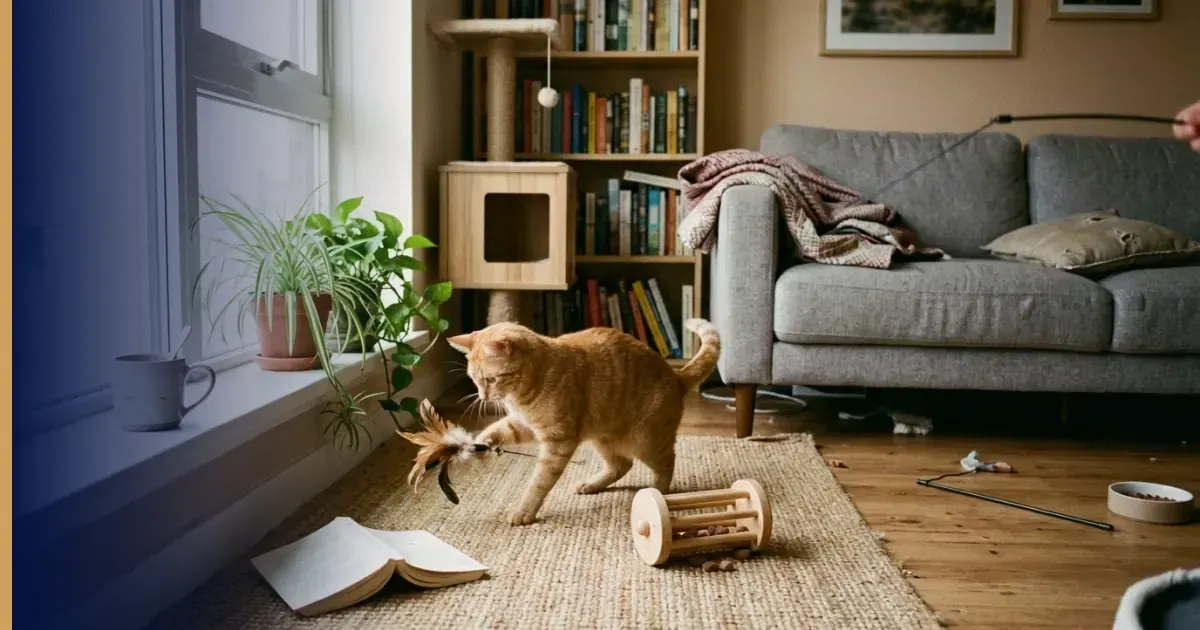
Indoor cats live safer, longer lives than those allowed to roam, but a flat without outlets for natural behaviour can leave a cat bored, frustrated or stressed. The answer is not more space—it is the right kind of space, used in ways that mirror what a cat would seek outdoors. Charlotte Animal Behaviour guides owners through practical enrichment that meets feline instincts for climbing, hunting and patrolling territory, even in a small home.
Vertical space matters more than floor area
Cats are climbers. In the wild they survey from height, rest above ground level and escape threats by going up. A flat with nothing above waist height feels exposed to a cat, no matter how many square metres it covers.
Wall-mounted shelves arranged as stepping-stones let a cat move around a room at different heights. Each shelf should be wide enough to lie on—a handspan at minimum—and spaced so a cat can jump between them without strain. A shelf near a window adds interest; one above a radiator in winter becomes a favourite resting spot.
Tall scratching posts and cat trees serve the same purpose, but they take up floor space. A mix of wall shelves and freestanding furniture gives more routes through a room. The goal is a three-dimensional environment where the cat can choose whether to move at floor level or overhead.
Resting places at different heights
Not every elevated spot needs to be part of a route. Cats spend much of their time resting, and they prefer to do so somewhere they can see the room without being easily reached. A high shelf with a cushion, a platform fixed to the top of a bookcase or a hammock strung under a chair all work. The key is choice: several resting places of different types mean the cat can pick the one that suits its mood.
Hunting behaviour does not disappear indoors
Cats hunt by instinct, not hunger. An indoor cat with a full bowl still has the drive to stalk, pounce and bat. Without an outlet, that drive can turn into ambushing ankles, knocking objects off shelves or pacing at dawn.
Feeding through puzzle toys redirects hunting behaviour into something productive. A puzzle feeder makes the cat work for each piece of kibble—pawing it out of holes, rolling a ball to release food or pulling treats from under flaps. The effort is the point: it mirrors the mental and physical work of catching prey.
Scatter feeding achieves the same thing with no equipment. Hide small portions of dry food around the room—under furniture, on shelves, inside cardboard boxes. The cat hunts by scent and sight, and the search takes longer than eating from a bowl. For cats that wolf food down, it also slows the meal and reduces vomiting.
Toys that mimic prey movement
A toy lying on the floor is not prey. Prey moves unpredictably, pauses, then bolts. A wand toy dragged slowly across the floor, hidden behind a chair leg, then flicked into the air triggers the stalk-and-pounce sequence. Ten minutes of this kind of play before bed can tire a cat enough to sleep through the night instead of waking you at dawn.
Battery-operated toys that move on their own work for some cats, but many lose interest quickly once they realise the toy follows a pattern. Rotate toys in and out of use every few days so they feel new each time.
Territory and scent markers
Cats are territorial. Outdoors they patrol a home range, marking it with scent from glands on their face, paws and flanks. Indoors they do the same, rubbing against furniture, scratching and, if stressed, spraying or middening outside the litter tray.
Scratching posts placed near doorways, windows and the cat's sleeping areas let the cat mark the spots that matter most. Horizontal and vertical scratchers give options—some cats prefer to stretch upward, others to dig claws into a flat surface. Redirecting scratching behaviour works better when the alternative is more appealing than the sofa arm.
Facial scent markers can be encouraged by placing items the cat already rubs—a particular corner, a chair leg—within easy reach of resting spots. Cats rub to self-soothe and to mark safe zones, so a home that smells like the cat reduces stress.
Avoiding territorial stress in small spaces
A cat in a small flat still needs distinct zones: one for eating, one for toileting, one for resting. Placing the litter tray next to the food bowl creates conflict—cats do not eliminate where they eat—and can lead to avoidance of one or both. If floor space is tight, use height to separate the zones. Feeding on a raised platform or moving the litter tray into a different room solves the problem without requiring more square footage.
In multi-cat households, territorial conflict shows as blocking, staring or chasing. Each cat needs its own escape routes and high resting spots where it cannot be cornered.
Sensory enrichment beyond sight and movement
Cats experience the world through scent, sound and texture as much as through vision. Enrichment that engages these senses keeps a cat interested in its environment.
Scent can be introduced through cat-safe plants such as cat grass or catnip, or by rubbing a toy with silvervine. Not all cats respond to catnip—the reaction is genetic—but silvervine and valerian root are alternatives. A few cats show no interest in any of them, and that is normal.
Texture matters in resting spots and scratching surfaces. A cat that ignores a plush bed may prefer a wicker basket or a cardboard box. Offering several textures and watching which the cat chooses tells you what to provide more of.
Sound enrichment is subtler. Some cats enjoy watching videos made for felines—footage of birds or fish moving on a screen. Others find it overstimulating. A radio left on low when the owner is out can provide company for a cat that dislikes silence, but it should not be loud enough to startle.
Practical steps to start this week
- Add one elevated resting spot the cat cannot currently reach—a shelf, a platform or a box placed on top of a wardrobe.
- Hide a portion of the next meal around the room and let the cat search for it.
- Move any scratching post to a location the cat already uses for scratching, even if that location is inconvenient for you.
- Offer two types of toy—one that mimics prey movement and one with a new texture—and note which the cat engages with.
- Check that the litter tray and food bowl are in separate rooms or, if that is not possible, at opposite ends of the same room.
Rotation keeps enrichment effective
A toy left out for weeks becomes part of the furniture. Rotating toys and puzzle feeders every few days makes each one interesting again when it reappears. The same applies to cardboard boxes, paper bags and other disposable enrichment—they are novel, then they are ignored, then they can be replaced.
Enrichment does not need to be expensive. A cardboard box with holes cut in the sides becomes a hiding spot and a puzzle. A paper bag left open on the floor is investigated, sat in, then abandoned. A pile of scrunched newspaper scattered with dry food creates a foraging game. The effort is in observing what the cat enjoys and offering more of it, not in spending money.
| Type of enrichment | What it provides | Low-cost option |
|---|---|---|
| Vertical space | Height for surveying and escaping | Wall-mounted shelves or a sturdy box stack |
| Hunting outlet | Mental and physical work before food | Scatter feeding or a cardboard tube with kibble inside |
| Scent marking | Territory control and stress relief | Scratching post near a door or window |
| Sensory variety | Engagement through texture, scent or sound | Cardboard, paper bags, cat grass grown from seed |
When behaviour suggests enrichment is not enough
Enrichment solves boredom and frustration, but it does not fix every problem. A cat that eliminates outside the litter tray despite territorial adjustments may have a medical issue or a learned aversion. Litter tray problems often need a different approach.
Aggression, excessive vocalisation or destructive behaviour that does not improve with enrichment may signal pain, anxiety or a social conflict that needs professional assessment. A qualified clinical animal behaviourist can observe the cat in its home environment and recommend a tailored plan.
This is an information site for general guidance only. Charlotte Animal Behaviour does not sell goods or services.
#Enrichment #Territorial behaviour
Download PDF: Indoor cat enrichment checklist PDF, 29 KB
Further reading
Frequently asked questions
What kind of enrichment do indoor cats need most?
Indoor cats need outlets for climbing, hunting and marking territory. Vertical space, puzzle feeders and scratching posts placed near key areas meet these drives better than more floor space or passive toys.
How often should I rotate my cat's toys?
Every few days. A toy left out continuously loses novelty and is eventually ignored. Rotating toys in and out of use makes each one interesting again when it reappears.
Can I enrich my cat's environment without spending money?
Yes. Cardboard boxes, paper bags and scatter feeding with the cat's usual kibble all provide enrichment at no cost. The key is variety and rotation, not price.