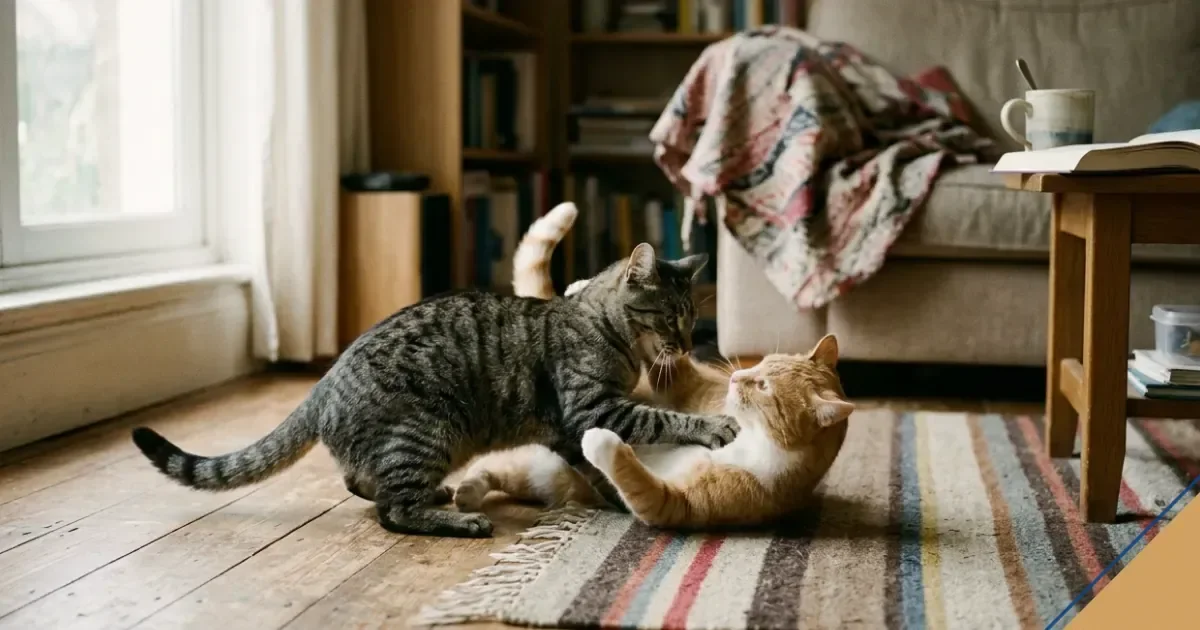
Cats wrestling on the floor look alarming until you recognise the six signals that tell play from real conflict
 Save
Cats playing together often look rough—rolling bodies, batting paws and open mouths—but genuine fighting involves tense postures, flattened ears and sustained noise that play rarely produces. The difference lies in body language, the rhythm of the interaction and whether both animals are choosing to stay. Charlotte Animal Behaviour walks you through what to watch for, when to intervene and how to keep a multi-cat household calm.
Body language shows intent before anything happens
A cat at play holds its ears forward or to the side, its body loose and its tail carried with a slight curve or question-mark tip. During a genuine fight, ears flatten against the head, the body stiffens and the tail lashes or puffs out. Pupils dilate in both situations, but a relaxed blink or a slow approach between bouts signals play; a fixed stare without breaking eye contact signals threat.
Watch the whiskers, too. Forward or neutral whiskers belong to a cat enjoying itself; whiskers pinned back tight to the face mean the animal is frightened or defensive. A cat that arches its back sideways, turning its body to look larger, is displaying—not playing.
Turn-taking reveals whether both cats want to continue
Play involves role reversal. One cat chases, then becomes the chased; one pins, then gets pinned. The exchange happens every few seconds, and neither animal holds the advantage for long. In a real fight, one cat dominates throughout and the other tries to flee or stays pressed to the ground. If you see one animal repeatedly trying to leave and the other blocking its path or pursuing it across the room, that is no longer play.
Pauses matter just as much. Cats at play break off every ten to twenty seconds, often sitting a short distance apart before re-engaging. They may groom themselves briefly, adjust position or simply look away. Fighting cats rarely pause—or if one does break away, the other follows immediately, preventing any rest.
Sound distinguishes rough fun from distress
Play is mostly silent. You might hear the occasional chirp, a soft trill or a breathy huff, but extended yowling, hissing or growling points to genuine conflict. A single hiss can appear in play when one cat is startled, but repeated hissing from the same animal, or a low growl that rises in pitch, signals fear or pain.
Screaming—a high, sharp shriek—means someone is hurt or badly frightened. If you hear that, separate the cats calmly and check for injuries. Silence does not always mean safety; some cats fight quietly, especially if one has learned that vocalising brings no relief.
Claw and bite control shows restraint
Cats playing together keep their claws mostly sheathed or use them lightly, leaving no scratches on each other's skin. Bites land without breaking the skin, mouths close gently and the bitten cat does not flinch away. A cat that bites hard, holds on or rakes with its hind claws has moved beyond play. After a genuine bite, the victim usually retreats immediately or retaliates with equal force; after a play bite, both cats carry on as before.
Check their bodies after the session. Play leaves fur slightly dishevelled but no bald patches, no punctures and no limping. Blood, even a small amount, means the interaction was too rough. Cats living together in harmony do hurt each other occasionally during play—bite inhibition is learned, not automatic—but frequent injuries suggest the relationship needs attention.
Context and routine show whether the behaviour is stable
Play happens predictably: in the morning after breakfast, in the evening before settling down, or whenever a household event raises the cats' arousal. If the behaviour appears only when one cat is eating, using the litter tray or resting in a favourite spot, it is more likely territorial conflict or resource guarding adapted to a feline context. Play sessions between housemates who get along last a few minutes, happen several times a day and end with both animals relaxed. Fighting tends to escalate over days or weeks rather than resolve itself.
Age matters, too. Kittens and young adults play harder and longer than older cats. An adolescent cat repeatedly pouncing on a senior housemate may intend play, but the older animal experiences it as harassment if it cannot retreat or defend itself comfortably. Watch for mismatched energy: if one cat always initiates and the other always tries to hide, adjust their environment so the reluctant participant has high perches, separate rooms and escape routes that the younger cat cannot block.
What to do when you cannot tell the difference
Record a short video on your phone and watch it back at half speed. Slowing the footage makes pauses, ear positions and turn-taking easier to spot. If you are still uncertain after watching several sessions, assume the behaviour is stressful for at least one cat and separate them for a while. Reintroduce them gradually, starting with feeding on opposite sides of a closed door, then allowing supervised time together in a large room with multiple exits.
Some households benefit from a third option: let the cats see each other through a baby gate or a glass door for a few days, so they can assess each other's body language without the risk of contact. This works especially well when one cat has recently joined the household or when an established pair begins showing tension after a house move or a change in routine.
Steps to take today if you think your cats are fighting
- Separate the cats into different rooms without drama—no shouting, no grabbing—and give each access to food, water and a litter tray.
- Wait an hour, then allow them to see each other from a distance while you are present, ideally through a barrier or across a large space.
- Offer a high-value activity in each other's presence—feeding, play with a wand toy or brushing—so they associate proximity with something pleasant.
- Increase the number of resources in your home: an extra litter tray, additional water bowls and more resting spots at different heights reduce competition.
- Reintroduce them in supervised short sessions, extending the time only when both remain calm.
- If tension persists beyond a week or you see injuries, contact a clinical animal behaviourist who can assess the relationship and recommend a tailored plan.
When play becomes too rough even if both cats are willing
Over-aroused play can tip into aggression when excitement builds faster than either cat can regulate it. You will recognise this when the session suddenly intensifies—faster movement, harder contact, vocalisation that was absent before—and neither animal disengages. Interrupt calmly by tossing a soft toy away from both cats or creating a gentle distraction (opening a door, rustling a treat bag). Do not pick up either cat or place your hand between them; redirected aggression is common when arousal is high.
If this happens often, shorten play sessions before arousal peaks. Some cats benefit from solo play with puzzle feeders or battery-operated toys that let them burn energy without involving a housemate. Clicker training can teach a cue that means "pause and look at me", giving you a tool to interrupt escalation before it becomes a problem.
Table: play versus fighting at a glance
| Sign | Play | Fighting |
|---|---|---|
| Ears | Forward or to the side | Flattened against the head |
| Role reversal | Both cats take turns chasing and being chased | One cat dominates throughout |
| Sound | Mostly silent or occasional chirps | Hissing, growling, yowling or screaming |
| Claws | Sheathed or used lightly | Extended, scratching or raking |
| Pauses | Frequent breaks, both cats rest | No pauses or one cat prevents the other from leaving |
Living with cats who wrestle helps you read them faster over time
Familiarity teaches you each cat's particular style. Some are vocal players who chirp constantly; others stay silent even when delighted. One might prefer to be the chaser; another always initiates but retreats first. These patterns become predictable, and deviations from them—a usually chatty cat going silent, a gentle player suddenly biting hard—alert you to stress or pain before serious conflict develops.
Keep a simple log if your household is new or if tension appeared recently. Note the time of day, what happened immediately before the interaction and how long it lasted. Patterns emerge: play sessions that always start well but end badly after three minutes suggest arousal is building too fast. Sessions that begin with one cat ambushing the other from behind a corner might be territory-related rather than social play. Adjust the environment, the routine or the level of supervision based on what the log reveals, and revisit it after a fortnight to see whether your changes helped.
#Body language #Aggression #Territorial behaviour
Download PDF: Is It Play or Fighting? A Quick Checklist for Cat Owners PDF, 31 KB
Further reading
Frequently asked questions
How do I know if my cats are playing or fighting?
Watch for turn-taking, pauses and forward or sideways ears—all signs of play. Fighting involves one cat dominating, no breaks between bouts, flattened ears and sustained growling or hissing. Cats at play keep their claws mostly sheathed and rarely draw blood.
What does it mean when cats bite each other while playing?
Gentle biting with no skin puncture is normal during play—it mimics hunting practice. The bitten cat usually stays engaged rather than fleeing. Hard bites that break skin or cause the other cat to scream or retreat immediately signal the session has become too rough or has moved into genuine conflict.
Should I stop my cats from wrestling on the floor?
Only if one cat is trying to leave and cannot, if you hear distressed vocalisation or if the session lasts so long that both become over-aroused. Brief, balanced wrestling with pauses is healthy social behaviour. Interrupt calmly by distracting them with a toy rather than grabbing either cat.