Clicker training works because timing shapes behaviour more clearly than words ever can
 Save
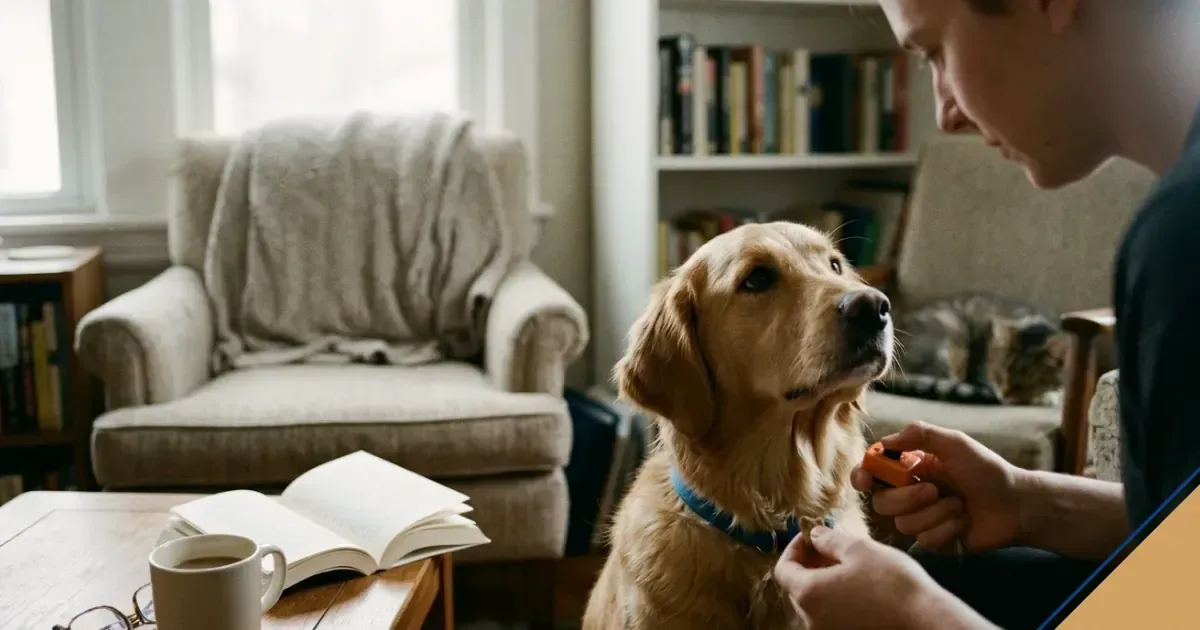
Clicker training is a marker-based method that uses a short, consistent sound—usually a small handheld device that clicks—to tell your dog or cat the precise instant they've done something you want. The click marks the behaviour, then a reward follows. This two-step process makes learning faster and clearer because the timing is exact, and your pet always knows which action earned the treat. Charlotte Animal Behaviour breaks down how the marker principle works, why it suits so many training situations, and how you can start using it today.
The marker principle turns a click into information your pet can use
A clicker is neutral: it carries no emotion, no frustration, and no variation in pitch. When you press it, the sound is identical every time. Your pet learns that this sound predicts a reward, so the click itself becomes valuable—a bridge between the action and the treat that follows a moment later.
The gap between behaviour and reward in traditional training can confuse an animal. If you say "good dog" three seconds after your dog sits, they might think the praise is for looking at you, or for standing back up. The click happens in a fraction of a second, so there's no ambiguity. Your pet connects the click to the sit, not to what comes after.
Because the marker is always the same, your pet doesn't have to interpret your mood or guess what your tone means. They just need to remember: click equals treat. That clarity speeds up learning and keeps sessions calm.
Charging the clicker builds the association before you ask for anything
Before the clicker means anything, you teach your pet that the sound predicts food. This process is called charging, or loading, the clicker. It takes one or two short sessions and requires no commands.
- Sit somewhere quiet with your pet, a clicker and a handful of small, high-value treats.
- Press the clicker once, then immediately give a treat—within one second.
- Repeat this ten to fifteen times: click, treat, pause, click, treat.
- Watch for a reaction to the sound—ears perking, eyes turning to you, or moving toward your hand.
- Test the association by clicking when your pet isn't looking at you; if they turn expectantly, the clicker is charged.
Once the click predicts the treat, you can use it to mark any behaviour you want to encourage. The clicker is now a tool, not just a noise.
Timing is the reason clicker training shapes complex behaviours so cleanly
Voice praise is slow. By the time you say "yes" or "good," your dog may have moved, looked away, or done three other things. The clicker is instant, so it isolates the exact moment you want—the paw lifting, the sit starting, the eye contact.
This precision matters most when you're building a new behaviour in small steps. If you're teaching a dog to touch a target with their nose, you can click the instant the nose moves toward it, even before contact. Your dog learns what to repeat because the feedback arrives at the right microsecond.
Trainers call this splitting: breaking a behaviour into tiny increments and rewarding each one. The clicker makes splitting possible because the timing is so tight. Without it, you'd struggle to communicate which part of a movement you liked.
The method suits both dogs and cats because it never involves force
Clicker training is a form of positive reinforcement: your pet chooses to offer a behaviour because they've learned it leads to something good. There's no leash correction, no raised voice, no physical manipulation. For cats, who rarely tolerate pressure, this makes training feel like a game rather than a demand.
Because the click is emotionally neutral, it works well in situations where your pet might be anxious or easily startled. A loud "yes!" can over-excite a nervous dog or spook a sensitive cat; the clicker stays consistent and calm. You can mark good choices—walking past a trigger without lunging, settling on a mat while visitors arrive—without adding arousal to the moment.
The method also suits pets who've had negative experiences with training. The clicker has no history, no association with past corrections. It starts fresh, and many animals respond more confidently to it than to verbal cues they've heard in stressful contexts before.
Shaping lets you teach behaviours your pet has never offered before
Shaping is the process of rewarding small approximations of a final behaviour, gradually raising your criteria as your pet improves. The clicker makes shaping practical because you can mark progress in real time.
For example, if you want to teach a dog to close a door, you might start by clicking any glance at the door, then any step toward it, then a nose touch, then a paw lift, then a harder push. Each session builds on the last. Your dog isn't guessing what you want—the click tells them when they're moving in the right direction.
| Stage | What you click | What comes next |
|---|---|---|
| Attention | Looking at the door | Wait for a step toward it |
| Approach | Moving closer to the door | Click only when they touch it |
| Contact | Nose or paw touching the door | Mark a push, not just a touch |
| Action | Door moving even slightly | Raise criteria to a full close |
Shaping takes patience, but it lets you build behaviours that would be impossible to lure or physically prompt. It also keeps training interesting for your pet, because they're problem-solving rather than simply following a treat.
Fading the clicker keeps the behaviour strong once your pet understands the cue
The clicker is a teaching tool, not a permanent fixture. Once your pet reliably offers a behaviour on cue, you can phase out the marker and rely on intermittent rewards instead. The behaviour doesn't disappear when the clicker goes away, because the real reinforcement was always the treat, play, or other reward that followed.
Start by clicking every correct response while the behaviour is new. Once your pet performs it confidently, click less often—perhaps three times out of five, then once out of three. Eventually, you'll mark only the best versions of the behaviour, or surprise your pet with a click after they haven't heard it in a while. This variable schedule keeps the behaviour strong and your pet engaged.
Some trainers keep a clicker on hand for life, using it to polish existing skills or teach new ones. Others retire it once a behaviour is fluent and the verbal cue is enough. Both approaches work; the clicker is a means, not the goal.
Common mistakes slow progress but are easy to fix once you notice them
Clicking too late is the most frequent error. If you click after your dog has stood up from a sit, you've marked standing, not sitting. Watch the behaviour closely and aim to click the instant it happens, even if that feels uncomfortably fast at first.
Clicking too often can also confuse your pet. If you click three times in quick succession, they won't know which moment earned the reward. One click marks one behaviour; more than that dilutes the information.
Another pitfall is failing to follow every click with a reward. The click is a promise. If you click but don't deliver, the marker loses its meaning and your pet stops trusting it. Even if you clicked by accident, give the treat—then adjust your timing for the next repetition.
The method integrates easily with other approaches you already use
Clicker training doesn't replace everything else; it sharpens what you're already doing. You can use it alongside lure-and-reward techniques, desensitisation protocols, or counter-conditioning for anxiety. The clicker simply adds precision to the moment you reward.
If you're working on recall, for instance, you might click the instant your dog turns toward you when you call their name, then reward with a treat or a game. If you're helping a cat feel calmer around a carrier, you can click for any relaxed behaviour near it—sniffing, sitting, lying down—and pair the click with a favourite treat. The marker fits into nearly any training plan that relies on positive reinforcement.
Some trainers use a verbal marker—a short word like "yes"—instead of a clicker, especially in situations where carrying a device isn't practical. The principle is identical; the clicker just offers slightly better timing and consistency for most people.
#Positive reinforcement #Desensitisation
Download PDF: Your first clicker training session checklist PDF, 29 KB
Further reading
Frequently asked questions
How does clicker training work for dogs who are easily distracted?
Start in a quiet room with no distractions and very short sessions. The clicker's neutrality helps because it doesn't add excitement. Once your dog understands the marker in a calm setting, gradually introduce mild distractions and click for focus. The precision of the click makes it easier for a distracted dog to learn what earns the reward.
What is the difference between a clicker and just saying "good dog"?
A clicker is faster and identical every time, so your pet knows exactly which behaviour earned it. Verbal praise varies in tone, speed and timing, which can confuse an animal learning something new. The clicker removes ambiguity and speeds up training, especially for complex or precise behaviours.
Can clicker training be used to stop unwanted behaviour?
Clicker training marks what you want your pet to do, not what you want them to stop. Instead of clicking to interrupt barking, you'd click for quiet moments or for an incompatible behaviour like lying on a mat. The method redirects your pet toward better choices rather than punishing unwanted ones.