Introducing a New Cat to a Resident Cat: A Calm Route Through Every Stage
 Save
Introducing a new cat to a resident cat works best as a staged process: keep the two animals fully apart at first, then introduce scent, then the closed door, then a brief sight of each other, and only then short supervised time together. Each stage moves forward when both cats look relaxed at the one before it. Below, Charlotte Animal Behaviour sets out those stages in the order a cat can accept them, with the signals that mean wait and those that mean step back. You need very little equipment: a spare room, two cloths and a pair of food bowls.
Cats need time to accept a new arrival, and a rushed first meeting sets both back
Cats are territorial, and a newcomer reads as an intruder long before it reads as company. Your resident cat has no way of knowing the arrangement is permanent, so its first job is to defend the space it already owns. That is why preparation matters far more than the first meeting itself. A nose-to-nose introduction on arrival day can produce a chase, a swat and a fear that takes a long time to unpick.
Full separation gives the newcomer a base and the resident cat a breather
The new cat needs one room to itself at the start: a door that closes, a litter tray, water, food and somewhere to hide. This is not a punishment, and it is not a quarantine for its own sake. It gives the newcomer a small territory to feel safe in, and it lets your resident cat keep the run of the rest of the house as normal.
A safe room needs a door, a tray and somewhere to hide
Pick a room the resident cat does not need to walk through, such as a spare bedroom. Put the litter tray at one end and the food at the other, because cats prefer not to eat beside their toilet. A cardboard box on its side or a covered bed gives the new cat somewhere to disappear into. Spend quiet time in there yourself, and add a little enrichment for an indoor cat so the room offers something to do as well as somewhere to sleep.
Scent swapping does quiet work before either cat sees the other
Before any face-to-face contact, let each cat meet the other's smell in a place that already feels safe. Stroke a soft cloth gently around the new cat's cheeks and chin, where the scent glands sit, then leave the cloth near the resident cat's favourite sleeping spot. Repeat in the other direction. Swapping bedding works on the same principle and costs you nothing.
- Keep a separate cloth for each cat so both scents stay readable.
- Leave the cloth where the other cat already rests, not in the middle of the floor.
- Wipe the same cloth along skirting boards and door frames at cat height.
- Repeat while both cats are settled rather than straight after a fright.
If a cat sniffs the cloth and walks away, that is a good result and needs no reaction from you. A hiss at a scented blanket tells you the next stage needs more time, not that the pair will never settle.
Feeding on opposite sides of a closed door pairs the newcomer's smell with good things
Set up two feeding stations on either side of the closed door, far enough apart at first that neither cat stops eating. Feed at the same times each day so the routine itself becomes the cue. As both cats eat calmly, bring the bowls a little closer over a run of meals.
The body language at the door tells you whether to continue
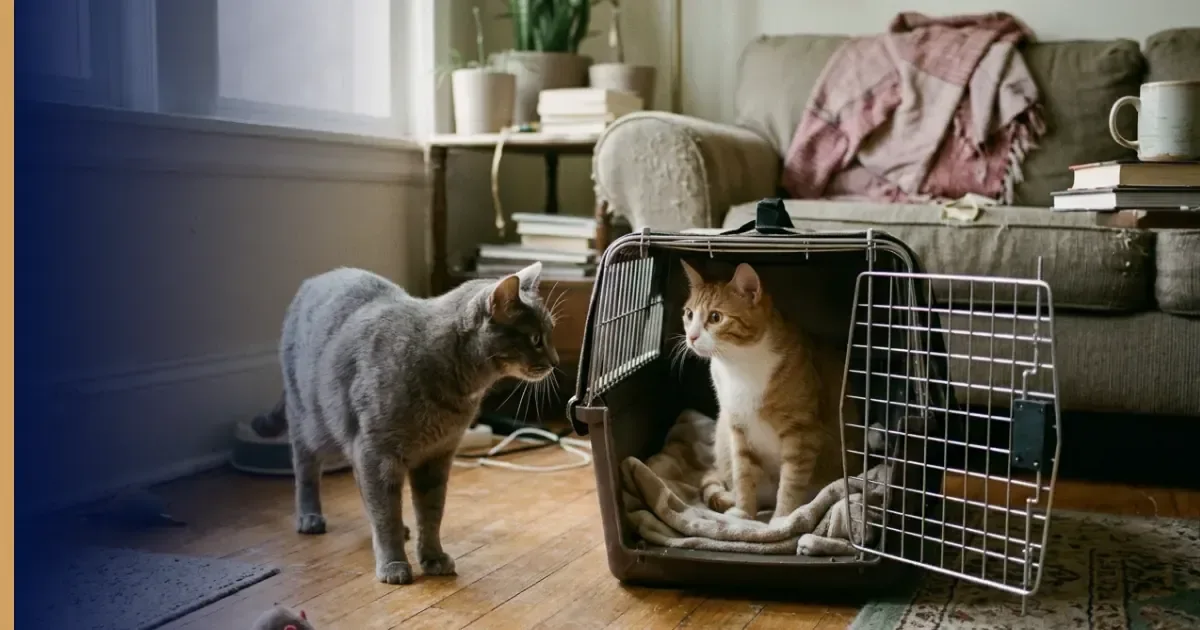
A cat that eats, grooms or settles near the door is telling you the smell is tolerable. One that stops eating, fixes on the gap or holds a low crouch is telling you the same thing in reverse. Watch for the whale eye, the sideways glance that shows the whites of the eye, and for ears turned flat or back, both of which mean a cat feels cornered.
The first proper look should be brief and end on a calm note
Open the door a crack, or fit a baby gate or a screen door, so the cats can see each other without any chance of contact. Keep the first session to the length of a meal and finish it while both are still eating. Then close the door and leave things there.
Never carry one cat towards the other in your arms. A cat with no exit will defend itself instead, and a fright of that kind costs more ground than a slow pace ever does.
Supervised time together grows in short sessions that both cats can cope with
Once both cats can eat near a screen without tension, let them share a room while you stay in it. Keep sessions short and end them first, before anything happens. A wand toy or a scatter of treats gives each cat something to do that is not watching the other. Watch how they use the space as well, because telling play from a real fight between cats is a skill worth having before the first tussle, and wrestling between cats can be play rather than conflict.
Separating them again is part of the plan, not a failure
Step in at the first stare-down, a low flicking tail, flattened ears or a slow stalk with a target. If one cat hides or goes off its food after a session, make the next one shorter and easier rather than skipping it altogether.
A reaction that looks like a setback means slow down rather than start over
A stall is not a failure. A hiss at a doorway, a swat through a gate or an afternoon spent under the bed are all requests for more distance. Go back one stage, stay there until both cats are easy again, and carry on from that point.
- A hiss followed by walking away – the cat is ending the exchange on its own terms.
- A swat with claws in and no follow-through.
- Two cats resting in the same room at opposite ends of it.
The pace belongs to the less confident cat. Pushing the bolder one forward only teaches the other that the house has become unpredictable.
The whole introduction fits into six steps you can start today
Work through these in order, and treat each one as a test rather than a countdown.
- Choose a room for the new cat with a door, a litter tray, water, food and a hiding place.
- Rub a separate cloth on each cat and leave it in the other cat's space.
- Feed the two cats on opposite sides of the closed door, starting further apart than feels necessary.
- Bring the bowls closer only while both cats keep eating.
- Fit a screen or a gate and let the cats watch each other through a meal, then close the door again.
- Share a room with both cats and a toy, and finish the session before either cat tenses up.
| Stage | What you are looking for | Time to move on |
|---|---|---|
| Separate rooms | The new cat eating, drinking and using the tray | Both cats settle into their own routine |
| Cloth swapping | Sniffing without a stare or a hiss | Each cat ignores the other's scent |
| Door feeding | Calm eating within earshot of the other cat | Bowls sit close with no cat leaving its meal |
| Screen meeting | Looking, then looking away | Both cats eat with the other in view |
| Shared room | Moving, playing and resting with an exit available | Sessions end calmly and nobody hides afterwards |
A behaviourist or your vet can help when things keep stalling
If a cat stops eating, starts using the floor instead of the litter tray, or shows sustained aggression rather than short warnings, speak to your vet first to rule out pain and illness. A clinical animal behaviourist can then look at the whole household, including the layout, the routine and the resources each cat is defending. Ask what qualifications the person holds and whether your vet can refer you.
This article is for general information only and is not a substitute for advice from your vet or a qualified behaviourist.
#Multi-cat household #Territorial behaviour #Stress signals
Download PDF: Introducing a New Cat: A Printable Checklist PDF, 29 KB
Further reading
Frequently asked questions
How long should the two cats stay apart at the beginning?
Until the new cat is eating, drinking and using its litter tray in its own room, and the resident cat is relaxed at the closed door. Work from what the cats show you rather than from a date on the calendar.
What are the signs that an introduction is going well?
Both cats eat normally, use the shared space without hiding afterwards, and can rest in the same room. Looking away after a stare, or walking off after a hiss, shows the cats are managing their own distance.