Six steps to stop a dog barking at visitors without suppressing what they feel
 Save
Your dog barks at visitors because the doorbell or a knock announces a stranger entering their territory, and that triggers either protective alarm or uncontained excitement. Both responses escalate quickly, and shouting over the noise makes it worse. Charlotte Animal Behaviour walks you through six training steps that address the underlying drive, not just the volume, so your dog learns a calmer way to greet people at the door.
Why dogs bark when someone arrives
The doorbell is a learned cue that predicts a visitor. For some dogs, that prediction means a stranger might be a threat; for others, it means someone exciting has arrived and they cannot contain the arousal. Both states produce barking, but the emotion behind it differs.
Territorial barking warns intruders off. Your dog stands stiff, the bark is low and repetitive, and they may position themselves between you and the door. Excitement barking comes with a wagging tail, jumping, and a higher pitch. The dog wants to greet the person, but the anticipation overwhelms their self-control.
Punishing either response teaches your dog that visitors are even more stressful, because now the arrival coincides with your anger. The barking may stop in that moment, but the underlying anxiety or arousal remains, and the behaviour often returns or shifts to something else (lunging, whining, pacing).
What makes the barking worse
Shouting "No!" or "Quiet!" when your dog barks adds your loud voice to the chaos, and your dog hears it as you joining in. Physically restraining them (holding their collar, pulling them back) increases frustration, especially in an excited dog.
Letting visitors greet your dog immediately rewards the barking with the thing they wanted: attention and contact. The dog learns that barking works, and the behaviour strengthens. Inconsistency between household members confuses the dog further. If one person tells them off and another lets them jump up, the dog cannot work out what the rule is.
Six steps to train a calmer greeting
These steps rebuild your dog's response to the doorbell and to visitors entering the house. Work through them in order, and practise each one until your dog responds reliably before moving to the next.
- Desensitise the doorbell sound. Ring the doorbell (or play a recording of it) when no visitor is arriving. The moment it rings, toss a treat on the floor or give your dog a chew. Repeat several times a day until the doorbell no longer makes them rush to the door. This breaks the prediction that the sound always means a stranger.
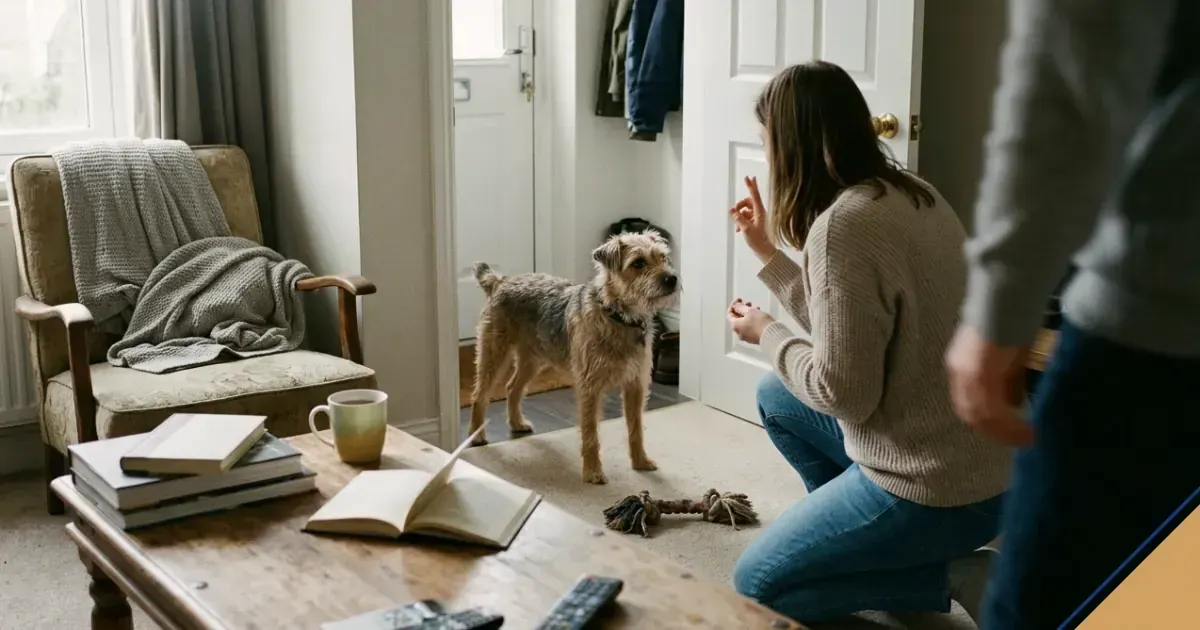
- Teach a "go to your spot" cue. Choose a mat or bed in sight of the front door but far enough back that your dog is not in the way. Lure them onto it with a treat, say "spot" or "place", and reward them for staying there. Practise when the house is calm, gradually increasing the duration before you release them.
- Add the doorbell to the cue. Ring the doorbell, then immediately ask your dog to go to their spot. Reward them for going and staying there. If they break before you release them, reset and try again. Repeat until they move to the spot as soon as they hear the bell.
- Introduce a helper at the door. Ask a friend to knock or ring the bell and wait outside. Send your dog to their spot, reward them, then open the door while your friend stays on the threshold. If your dog stays on the mat, reward them again. If they get up, close the door, reset, and try once more. Your friend should not enter until your dog holds the stay.
- Let the visitor in while your dog waits. Your friend steps inside and stands still. Your dog remains on their mat. Reward calm behaviour. If your dog barks or lunges, your friend steps back out and you start again. The rule is: the visitor only stays if the dog is quiet.
- Release your dog to greet. Once your dog has stayed calm for several seconds with the visitor inside, release them with a word like "okay" or "free". Let them approach the visitor, who should ignore them at first (no eye contact, no touch, no talking). If your dog jumps or barks, the visitor turns away. If your dog stays calm, the visitor can greet them quietly.
How long each step takes
Some dogs move through the first two steps in a handful of sessions; others need longer. Excitement barkers often learn faster than territorial barkers, because the arousal is easier to redirect. A dog with a strong guarding instinct may need several weeks of repetition before they trust that visitors are not a threat.
Practise twice a day in short sessions (five to ten minutes). More frequent, shorter sessions work better than one long session, because your dog's focus fades when they are tired or overstimulated.
What to do if your dog is anxious about strangers
Territorial barking often stems from anxiety, not aggression. Your dog believes they are protecting the household, and the barking is a warning to the intruder. Forcing them to be quiet without addressing the fear increases their stress.
Environmental changes that reduce dog anxiety help before you start training. Give your dog a safe space away from the front door where they can retreat if they feel overwhelmed. A room with a closed door, a covered crate, or a quiet corner where they cannot see or hear the visitor arriving reduces the trigger.
Counter-conditioning changes how your dog feels about visitors. Pair the arrival of a person with something your dog loves (high-value treats, a favourite toy, a long-lasting chew). The visitor does not interact with your dog at first; they simply exist in the same space while your dog receives rewards. Over time, your dog starts to associate strangers with good things rather than threat.
When to keep your dog separated
If your dog lunges, snarls, or snaps at visitors, separation is safer while you work on the behaviour. Put your dog in another room before you open the door, and only bring them out once the visitor is settled and your dog has calmed down. This is not a failure; it is management that prevents rehearsal of the aggressive response.
What positive reinforcement training does here
Positive reinforcement rewards the behaviour you want, making it more likely to happen again. When your dog stays on their mat as a visitor enters, the reward (a treat, praise, or release to greet) strengthens that calm response. Punishment (shouting, physical correction) might stop the barking in the moment, but it does not teach your dog what to do instead.
Positive reinforcement training works because it gives your dog a clear alternative. Instead of barking or jumping, they learn that going to their spot earns rewards. The new behaviour replaces the old one, rather than suppressing it.
Common mistakes that slow progress
Rushing the steps before your dog is ready undoes earlier progress. If your dog cannot stay on their mat when the doorbell rings, adding a visitor will fail. Go back to the previous step and strengthen it first.
Expecting perfection too soon sets you up for frustration. Your dog will have setbacks, especially if a visitor arrives unexpectedly or if someone in the household forgets the rule. Each mistake is information: it tells you which step needs more practice.
Using treats your dog is not interested in makes the reward meaningless. High-value treats (small pieces of cooked chicken, cheese, sausage) work better than dry biscuits, especially when your dog is aroused or anxious. The reward has to be worth more than the excitement or fear of the visitor.
How to manage real visitors while you train
Training takes time, and you will still have visitors arriving before your dog has learned the new routine. Put your dog behind a baby gate or in another room before you answer the door. This stops them rehearsing the barking and prevents the visitor from rewarding the behaviour by giving attention.
Once the visitor is inside and settled, bring your dog out on a lead. Ask them to sit or go to their mat, reward calm behaviour, and keep the lead loose. If your dog barks or lunges, lead them back to the other room and try again later. The visitor should not approach your dog; your dog approaches them when ready.
| Training approach | What it teaches | When it works best |
|---|---|---|
| Desensitisation | The doorbell does not always mean a visitor | Excitement barkers and mildly anxious dogs |
| Counter-conditioning | Visitors predict good things, not threat | Territorial barkers and fearful dogs |
| Alternative behaviour | Going to a mat earns rewards | All dogs, once the arousal is lower |
When to ask for help
If your dog's barking escalates to growling, snapping, or biting, a professional assessment is safer than training alone. A qualified behaviourist can observe your dog's body language, identify the triggers, and design a programme that addresses the specific anxiety or aggression.
Look for someone accredited by a recognised body, such as the Animal Behaviour and Training Council. They will work with you and your dog over several sessions, adjusting the plan as your dog progresses. Training a dog with serious territorial behaviour or fear-based aggression is not a quick fix, and expert guidance prevents the problem from worsening.
Early socialisation in puppies reduces the likelihood of territorial barking in adulthood, but older dogs can still learn new responses with patience and consistency.
#Territorial behaviour #Positive reinforcement
Download PDF: Checklist for training your dog to greet visitors calmly PDF, 29 KB
Further reading
Frequently asked questions
How do I stop my dog barking at the doorbell?
Desensitise your dog to the doorbell by ringing it when no visitor is arriving, then immediately giving them a treat or chew. Repeat several times a day until the sound no longer makes them rush to the door. Once the doorbell is neutral, teach them to go to a mat or bed when it rings, and reward them for staying there.
Why does my dog bark at strangers coming into the house?
Your dog barks at strangers either to warn them off (territorial behaviour) or because the excitement of a visitor overwhelms their self-control. Both responses are normal, but they need redirecting so your dog learns a calmer way to greet people.
What should I do if my dog barks and lunges at visitors?
Keep your dog separated in another room until the visitor is settled, then bring them out on a lead. Reward calm behaviour and ask the visitor not to approach your dog. If the barking or lunging continues, consult a qualified behaviourist, as this may be anxiety or territorial aggression that needs professional assessment.