What Is Positive Reinforcement Training? The Idea Behind Three Simple Steps
 Save
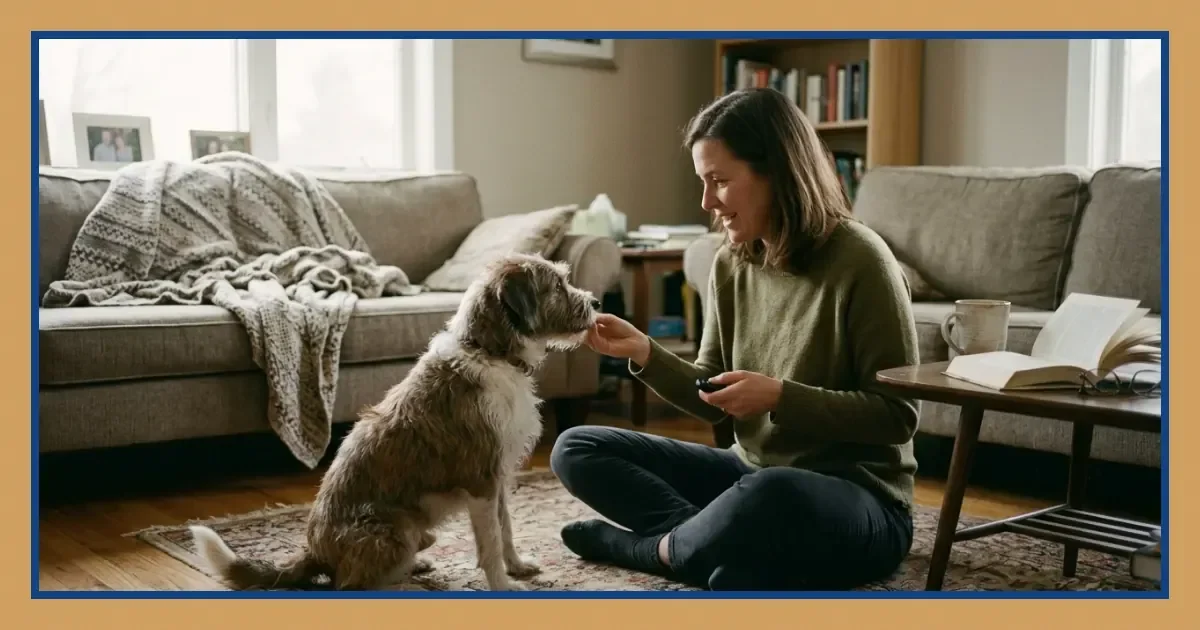
Positive reinforcement training means adding something your dog or cat wants straight after a behaviour you want to see again, so that behaviour becomes more likely next time. It sounds almost too simple to be a method. At Charlotte Animal Behaviour, we think that simplicity is exactly why it works so well once owners understand the mechanics underneath it, rather than just the treats and clickers that sit on top.
The principle behind positive reinforcement
Behaviour that gets rewarded tends to repeat. Behaviour that gets ignored or punished tends to fade, though not always in the way owners expect. Positive reinforcement training works with the first half of that rule: you are not trying to stop behaviour so much as build a different one in its place.
This is different from telling a dog or cat "no". A correction might suppress an action in the moment, but it does not tell the animal what to do instead. Rewarding a sit, a calm greeting or a scratch on the right post gives a clear, repeatable answer, which is why the behaviour sticks without the fallout that comes from fear-based methods.
Why timing matters more than the treat itself
The reward has to land within a second or two of the behaviour, or the connection your pet is meant to make gets blurry. A treat given five seconds after your dog sits might end up rewarding the stretch, the sniff, or the glance at you instead of the sit itself.
This is the whole idea behind clicker training: the click marks the exact instant the behaviour happens, and the treat follows after, even a moment later. If you want to see how that timing principle plays out in practice, our piece on clicker training walks through it step by step.
What counts as a reward
Food is the obvious one, but it is not the only one. A reward is anything your pet will work for, and that varies more than people assume.
- Food, in small enough pieces that you can repeat it many times in a session without filling your pet up
- Play, such as a short game with a favourite toy for a dog that cares more about tugging than treats
- Access, like opening the door to the garden the moment a dog sits instead of barging through
- Attention, including a calm word or a stroke, though this tends to work best alongside something stronger
Watching which of these your own pet chooses when given the option tells you more about what will motivate them than any general rule does.
Force-free training methods and where the term comes from
Force-free training is the wider umbrella that positive reinforcement sits under. It covers any method built on reward and choice rather than physical corrections, startling sounds or equipment designed to cause discomfort.
Reward based dog training and force-free approaches overlap heavily, but they are not identical. A force-free trainer might also remove a dog from a situation that triggers unwanted behaviour, using desensitisation to lower the dog's reaction over time, rather than only rewarding the alternative. Positive reinforcement is one tool within that broader philosophy, not the whole of it.
How to start using it at home
You do not need a course or special equipment to begin. A handful of treats, a few spare minutes and some patience cover most of what a first session needs.
- Choose one behaviour to reward, such as sitting when you pick up the lead, rather than several at once
- Catch the behaviour the instant it happens and reward within a second or two
- Use small, soft treats so you can repeat the exercise many times without a long pause between each one
- Practise in a quiet room first, then move to busier spaces once the behaviour is reliable
- Reward every time at first, then gradually reward only the best examples once the behaviour is established
- End each session while your pet is still keen, rather than pushing on until they lose interest
Where this method runs into trouble
Owners usually hit one of two problems. Either the reward arrives too late to mean anything, or the animal is rewarded for being near the right behaviour rather than for the behaviour itself, such as treating a dog that is still half standing up during a sit cue.
Another common snag is rewarding too unevenly to build a reliable habit. Puppies learning to settle, dogs with a lead-pulling habit, and kittens learning where to scratch all need frequent, consistent repetition before the behaviour holds up under distraction. If the issue is a puppy mouthing hands rather than settling on cue, our guide on stopping puppy biting covers how the same reward timing applies there.
Positive reinforcement compared with other approaches
| Approach | What it adds or removes | What the animal learns |
|---|---|---|
| Positive reinforcement | Adds a reward after the wanted behaviour | This behaviour pays off, so repeat it |
| Negative reinforcement | Removes something unpleasant when the behaviour happens | Doing this makes the pressure stop |
| Positive punishment | Adds something unpleasant after an unwanted behaviour | This behaviour leads to something bad |
| Negative punishment | Removes something wanted after an unwanted behaviour | This behaviour costs me something good |
Most force-free trainers lean almost entirely on the first row, because it builds behaviour without the stress responses the other three can trigger.
Where it fits alongside other training work
Positive reinforcement is not a cure-all on its own. A dog that guards food or toys needs the groundwork described in our article on resource guarding in dogs before reward-based cues will stick. A puppy meeting new people and places for the first time benefits from pairing calm exposure with reward, which our guide on socialising a puppy sets out in more detail.
The reward teaches the behaviour. The timing is what makes the lesson land.
#Positive reinforcement #Clicker #Desensitisation
Download PDF: Starting positive reinforcement training at home PDF, 28 KB
Further reading
Frequently asked questions
Does positive reinforcement training work for cats as well as dogs?
Yes, the same principle applies to cats, though the rewards differ. A cat is more likely to work for food, play with a wand toy, or access to a window perch than for praise alone.
What is positive training if it does not use any corrections at all?
Positive training builds wanted behaviour through reward rather than through stopping unwanted behaviour with corrections. It focuses on what you want your pet to do, then makes that choice the one that pays off.
How do I switch to reward based dog training if I have used corrections before?
Start by rewarding one simple behaviour consistently, such as a calm greeting, while dropping the correction for the matching unwanted version. Dogs adapt faster than owners expect once the reward is reliable and arrives at the right moment.