Six environmental changes that reduce dog anxiety before behaviour work begins
 Save
A nervous dog lives in a state of heightened alert, and that baseline affects everything else you try to teach. Before desensitisation or counter-conditioning can take hold, the dog needs a calmer starting point. The adjustments below lower stress through environment and routine—practical changes you can make this week that don't rely on formal training. You'll find step-by-step guidance on predictable routines, safe spaces, exercise balance and the sensory triggers most owners miss. Charlotte Animal Behaviour builds every plan on these foundations.
Predictable routines give a nervous dog something to rely on
Dogs read patterns, and a nervous dog watches for them constantly. When meals, walks and rest happen at roughly the same time each day, the dog stops scanning for the next surprise. Predictability doesn't mean rigidity—shifting by half an hour won't undo the benefit—but it does mean structure. Feed at the same end of the morning window, walk the same route on weekdays, settle in the same room each evening.
Write the routine down for the first week so everyone in the household follows it. A nervous dog notices when one person lets them on the sofa and another doesn't, or when a walk sometimes happens after breakfast and sometimes before. Consistency across people matters as much as consistency across days.
A retreat the dog chooses reduces constant vigilance
Every dog needs a place they can withdraw to without being followed, touched or stared at. For a nervous dog that retreat becomes a pressure valve. It might be a crate with the door left open, a bed under the stairs or a corner of a quiet room—the location matters less than the rule that the dog is left alone when they go there.
Place the retreat away from through-traffic and facing the room so the dog can see the door. Add something with your scent (an old jumper works) and keep the area dim if possible. Never reach into the retreat to stroke the dog, call them out or remove a toy. The space only works if the dog learns that choosing it means the world stops making demands.
What a retreat looks like in practice
A covered crate in the corner of the living room, door clipped open, with a blanket inside and a water bowl nearby. The family walks past it but never stops beside it, never speaks to the dog when they're in it and never reaches in. The dog learns within days that retreat equals rest.
Sensory thresholds drop when the environment is quieter
Nervous dogs often live in homes that feel normal to their owners but overwhelming to them. The television stays on, visitors come and go, children run through rooms and doors slam. Each sound or movement nudges the dog closer to threshold—the point where they can no longer cope and react with fear or avoidance.
Lower the baseline by turning the television down or off when no one is watching it, closing doors gently, asking visitors to ignore the dog for the first ten minutes and keeping the dog out of the room during loud activities (vacuuming, music practice, arguments). You're not eliminating stimulation—you're reducing the cumulative load so the dog has capacity left to handle the things they can't avoid.
| Trigger | Why it raises stress | Simple adjustment |
|---|---|---|
| Television or radio left on | Unpredictable volume and voices the dog can't place | Turn off when not actively watched |
| Visitors arriving without warning | Sudden entry into the dog's space | Ask visitors to text before arriving; dog goes to retreat first |
| Fast movements in peripheral vision | Dog can't assess intent quickly enough | Slow down around the dog; avoid sudden gestures |
| Direct eye contact from strangers | Reads as confrontation or threat | Ask visitors to look at the dog's shoulder, not their face |
Exercise needs balancing—not eliminating—for an anxious dog
Under-exercised dogs build frustration that looks like anxiety; over-exercised nervous dogs stay in a heightened state and never wind down. The right amount depends on breed, age and individual temperament, but the pattern is more important than duration. A nervous dog does better with two short walks than one long one, and better with a walk that ends calmly than one that finishes at the busiest point.
Aim to bring the dog home tired but not frantic. If they're still pacing an hour after the walk or panting heavily indoors, the walk was too stimulating. If they're restless all evening, it wasn't enough. Adjust by ten minutes at a time and watch how the rest of the day unfolds.
Mental work tires a nervous dog more effectively than physical distance. Scatter feeding (throwing their meal across the garden so they have to search for each piece) or a snuffle mat gives the brain something to focus on that isn't the environment. It's low-arousal activity that satisfies without ramping up stress.
Physical contact works only when the dog initiates it
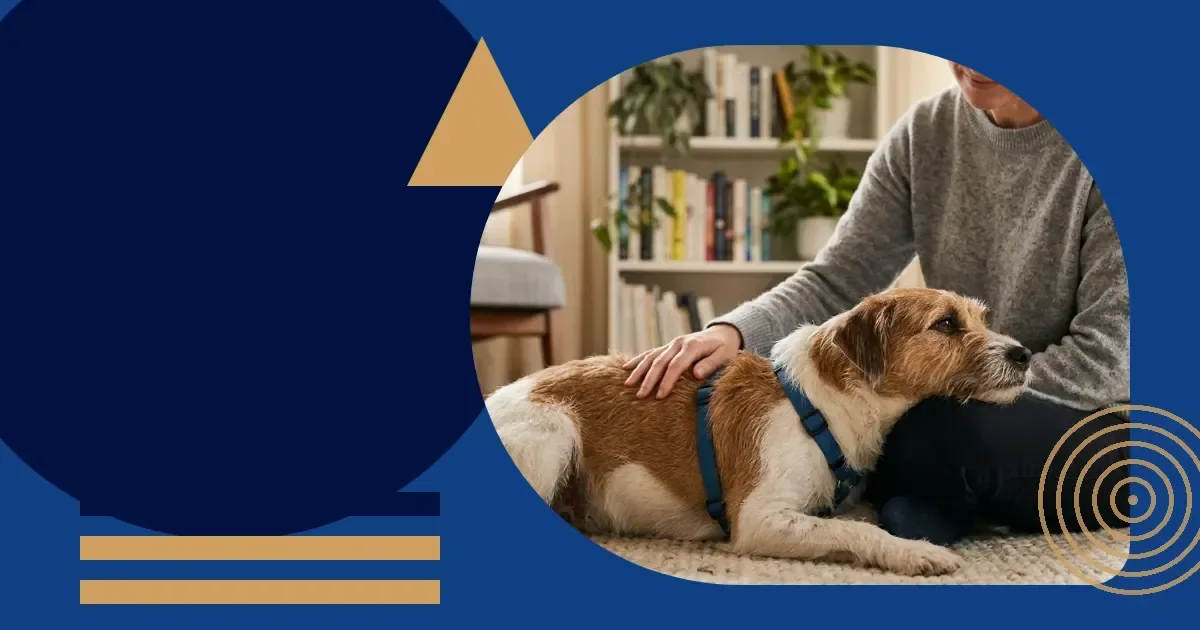
Stroking a nervous dog because you want to reassure them often does the opposite. The dog can't leave, can't control the interaction and may freeze rather than pull away—freezing looks calm but isn't. Touch becomes a stressor, not a comfort.
Let the dog come to you. When they do, stroke once or twice under the chin or on the chest (not over the head) and then stop. If they lean in or nudge your hand, continue. If they step back or turn away, respect it. You're teaching the dog that closeness is safe because it's always their choice.
Signs the dog is tolerating touch, not enjoying it
Whale eye (white showing at the corner of the eye), a closed mouth, stiffness through the body, turning the head away while the body stays still or moving away the moment you stop. Each of these signals says the dog wants the interaction to end, even if they haven't growled or snapped.
Food routines affect stress more than most owners expect
Feeding in a high-traffic area, from a bowl that slides across the floor or while another dog watches creates low-level tension every mealtime. A nervous dog may eat quickly, guard the bowl or avoid eating altogether. Move the bowl to a quiet corner, use a non-slip mat underneath and feed other pets in separate rooms.
Some dogs find slow feeders or puzzle bowls stressful rather than enriching—if the dog is pushing the feeder around, whining or giving up, go back to a standard bowl. The goal is calm eating, not challenge. Resource guarding during meals is common in nervous dogs; if your dog stiffens or growls when approached near food, this guide explains the early signs and what they mean.
Steps to create a lower-stress baseline this week
- Set fixed times for meals, walks and evening rest; write them where everyone can see them.
- Prepare a retreat in a low-traffic area and enforce the rule that the dog is never disturbed there.
- Turn off background noise (television, radio) unless someone is actively using it.
- Replace one long walk with two shorter ones, ending each before the dog becomes overstimulated.
- Move the dog's food bowl to a quiet corner and feed other pets separately.
- Let the dog initiate all physical contact for the next week and respond with brief, gentle touch.
When environmental change alone isn't enough
These adjustments build a foundation, but they don't replace behaviour modification when a dog's anxiety is severe or specific. Desensitisation and counter-conditioning work best once the dog's baseline stress is lower. If your dog is struggling with separation, this article walks through the six signs that separate normal goodbyes from real distress.
An accredited clinical animal behaviourist can assess triggers, build a tailored plan and work with your vet if medication would help. The RSPCA and the Animal Behaviour and Training Council both maintain registers of qualified professionals. Positive reinforcement methods give nervous dogs the clearest, kindest route to confidence.
Reducing anxiety in a nervous dog takes time, but the changes above create a measurably calmer home within a fortnight. Each adjustment removes one small demand on the dog's capacity to cope, and together they give the dog room to learn that the world is less overwhelming than it seemed.
Download PDF: Weekly checklist to lower your dog's baseline stress PDF, 30 KB
Further reading
Frequently asked questions
How long does it take to reduce anxiety in a nervous dog?
Most dogs show a noticeable drop in baseline stress within two weeks of consistent environmental changes—calmer greetings, more settled rest periods and less scanning. Deeper confidence takes longer and depends on the dog's history and the severity of their anxiety.
What are the main signs that a dog is anxious rather than just energetic?
An anxious dog often shows whale eye, excessive panting when not hot, pacing, inability to settle even after exercise, avoidance of certain rooms or people, and a tucked tail or lowered body posture. Energy looks looser and more playful; anxiety looks tense.
Can I use calming supplements or sprays to help manage my dog's stress?
Some dogs respond to supplements or pheromone diffusers, but they work best alongside environmental changes, not instead of them. Speak to your vet before starting any supplement, and don't rely on products alone to address the underlying causes of anxiety.